
I really enjoyed Atmosphere. Taylor Jenkins Reid takes a premise that could easily have become either too technical or too sentimental and finds a mostly convincing balance that I really enjoyed.
Plot in a Nutshell
Atmosphere is a dual timeline novel following gifted scientist Joan in a series of rich and detailed flashbacks as she navigates the selection and training process to become an astronaut – as one of the first women to be allowed to try.
These chapters are contrasted with a current day storyline where, at Mission Control she strives to help a crew survive a terrible incident in space.
There is also a rich and beautiful love story at the heart of the novel.
Thoughts
One of the strongest parts of the novel is the NASA setting. I went in slightly wary that the science might become too much: too technical or too detailed. But overall, I found it well balanced. The astronaut selection and training process feels convincing but is not dry, and the period detail has the same quality. It feels carefully researched but not showily researched. There is no sense of the book pushing references at you, or dressing itself up in kitschy nostalgia.
What really works is the atmosphere around the shuttle programme itself. Reid captures a sense of hopefulness. There is ambition and belief. All the characters give a sense that they are part of something larger than themselves. The book understands the technical seriousness of the work, but also the emotional significance it carries for the would be astronauts and for the people following the space race at home. Space is not just a backdrop here. It is both an idea and a vocation, and for Joan, something close to a way of understanding life.
The pressures on the women were particularly interesting and well handled. The author does not shy away from showing the casual and not so casual sexism of the period. Each woman is fighting for their place and to be the first and in that sense are pitted against each other in a really high stakes experience. But this is also offset by respect, loyalty and teaming. That balance felt very real. The book does not sentimentalise the team into a simple ‘found family’ trope but it does show a deep and powerful sense of connection.
Joan herself was a great main character. She is clearly brilliant, kind, creative and emotionally open, and we meet her gradually watching as she opens up and learns about herself. That matters, because on paper Joan could risk becoming a little Pollyanna-ish. She is smart, probably much prettier than she realises, good-hearted, imaginative, and deeply attuned to the beauty of the universe. There are moments where she edges close to being too good to be true. But because we meet her gradually and in layers, she rarely feels like perfection on a page. Her love of science, her thoughts about the universe, and the way space shapes her inner life are genuinely beautiful but she is also flawed.
I also loved Joan’s relationship with her niece. It gives the novel another emotional level and deepens our sense of Joan and her values and sense of self. The one relationship that worked less well for me was with her sister, who felt more two-dimensional: troubled, difficult, and somewhat flattened into the role of the bad or damaged sibling. Compared with the care given to Joan and the ensemble, that felt a little basic and lacking in nuance.
The supporting cast is strong. Vanessa is particularly intriguing, but Lydia and Griff also stand out. There was enough of the group to make the team feel real, without letting the ensemble swallow Joan’s story. That is a difficult thing to manage. In a novel about a collective effort, it would be easy either to overstuff the cast or make the side characters feel purely functional.
I did want more of Vanessa. She is fascinating, but we mostly see her through what she chooses to reveal, or through Joan’s perception of her. That makes sense for a novel of its size but also at times felt a little coy. A few other perspectives on her might have made the relationship richer and given the romance even more detail and weight.
The romance itself is beautiful. It is sensitively written, and it feels authentic. I appreciated that the book allows for difficulty: fights, hesitation, fear, and the strain of coming together under circumstances that make living openly and authentically dangerous. The need to remain closeted, especially within the military-adjacent world of NASA at the time, feels realistic and painful without being overplayed.
That said, the romance is more central than some readers may expect. Anyone coming to Atmosphere primarily for the space programme may find the balance different from what the blurbs suggest. This is not a flaw exactly, but it is worth knowing. The novel is interested in NASA. But I felt it was just as much about intimacy, loneliness, and what it means to be seen and appreciated by another person.
Structurally, I liked the opening tension and shape overall. I liked beginning with the knowledge that something has gone wrong, then moving backwards to build an understanding of the characters. It gives the book momentum and emotional pressure. But it can feel a little choppy, and the final stretch feels rushed. Not necessarily the resolution of the central problem, but Joan’s own ending . Another thirty or forty pages might have given that part the space it deserved. There are also moments where the novel leans a touch too romanticised, even slightly preachy. However Atmosphere is a hopeful, moving and beautifully written novel about space, love, pressure and connection. Yes it’s slightly rushed at the end. Yet remained vivid enough that I was glad to have been pulled into its orbit (I know, I know ;-))
A Final Note
Whilst entirely different novels Conlave – Robert Harris is another novel set in the center of an epic moment.
Reading this also sent me down the rabbit hole of female astronauts and astronaut traning. I found this an interesting and short read.
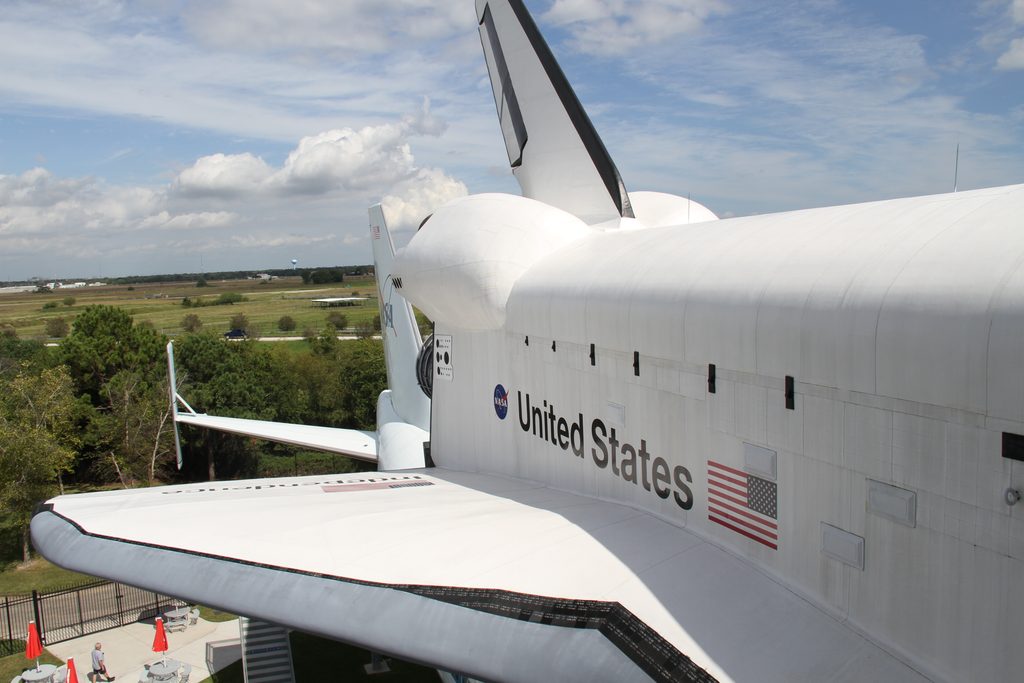
The shuttle on top of a 747 at Independence Plaza, Houston