
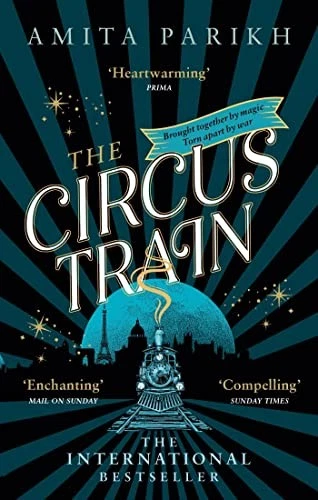
There is a genuinely good novel buried inside The Circus Train. I’m just not sure Amita Parikh ever decided exactly what it could be.
Plot in a Nutshell
The Circus Train follows Lena the daughter of a renowned illusionist as she and her father travel with the World of Wonders circus and life beyond. A childhood bout of polio has left her reliant on a wheelchair, an experience that shapes her worldview. As the Nazis take power across the continent, the sheltered, self-contained world of the train comes under threat, and Lena must find a way to exist outside the only home she has known
Thoughts
I enjoyed many individual parts of this book whilst still be frustrated by the whole. I loved The World of Wonders as a micro world. The train is far more than a means of moving the characters from place to place. It becomes a home, a community and almost a character in its own right.
The performances and the performers Horace had gathered felt like they offered great potential. This is not simply a conventional travelling circus built around a “roll up, roll up” atmosphere and a collection of individual acts. It felt more theatrical and sophisticated, closer to a Cirque du Soleil-style spectacle than a Sunday-afternoon big top. The showmanship, and commitment to the artistry were immersive and interesting. I also liked the community that had formed around the train and the sense that its inhabitants had created a world of their own, when perhaps they would have been less welcome in the ‘real world’.
I also felt this created a broader sense of travel and exploration that was really fun. Although the train itself is the novel’s most important place, there is a sense of movement and experience whilst Horace is genuinely a man of the world. He travels widely in search of the very best performers, whether he finds them in Greece, Romania or somewhere else entirely. He is willing to bring together people of different backgrounds and nationalities, provided they can contribute to the spectacle and help make the enterprise successful. This is of course not entirely altruistic. Even so, the international and diverse nature of the World of Wonders felt like a sense of possibility and excitement.
If the world of the train was diverse I also think Lena was well drawn and her disability handled sensitively. Her medical progress did not feel like a simplistic moment in which the person who could not walk was suddenly “fixed.” Instead, the novel presents her experience as an ongoing journey. It recognises that by this point in time polio did not necessarily mean a lifetime spent using a wheelchair. However it does not underestimate the impact it had on Lena’s body, identity and relationships.
On this latter point the book also explores the way other people see and judge her. Her wheelchair affects how people connect with her, what they assume she is capable and whether they want to build a relationship with her.
This creates an interesting tension in Theo’s treatment of Lena. He loves her deeply and wants to protect her from what he sees as the cruelty of the world. However, that protection is controlling. He limits her agency and is fearful of her discovering her own potential. I loved seeing her make her own way in the world with strong female friendships and personal development. They were much more interesting than the two somewhat flimsy love storylines.
The love story at the centre of the novel felt surprisingly weak. Friends to lovers is a trope for a reason but here it felt like it built too early when Lena was too young. It lives on and maintained without a good reason ever being seen.
Whilst I knew a group of highly different people travelling across Europe in the 1930s was going to run up against history that happened really abruptly. That said, the sections set in Theresienstadt were some of the most compelling parts of the novel. The reality of life, in what was positioned as a model town, and the brutality of that experience will stay with me.
Ultimately though I found the book did not seem to know exactly what it wanted to be. From a plot perspective it felt confused and could have benefited from fewer arcs. It could absolutely have been a deeper historical novel focused on Theresienstadt. It could have been a rich exploration of the World of Wonders and the people who created a home aboard the train. Even the family and personal growth storylines could have developed more. Instead, the novel tries to be a circus novel, a disability narrative, a coming-of-age story, a wartime novel, an escape story, a family drama and a romance. In quite a slim novel these all compete for space without ever really developing.
By the end, the novel becomes a slightly wishy-washy love story. The romance overshadows and left the book feeling a little flat.
On the ending. I particularly disliked the final pages, which move rapidly through a series of time jumps: a year later, and then another year later, and then another. I’m not a fan of this kind of ending, and here it seemed lazy almost as if the author had run out of ideas or time.
Rather than allowing the characters’ later lives to unfold meaningfully, the ending reduces them to a sequence of updates. It reinforces the sense that the final part of the novel was rushed and that the book was trying to close too many storylines at once.
A Final Note
Whilst finding out more about Theresienstadt has gone on my never ending list of things to read this site has some good information.